To get Best Friend Forever access, register (it's free) or login below:

Where your music money goes

An ask Metafilter question that caught my eye: Will my money get to the musician, or all end up with the record label?

Interesting question to me, but maybe not for the reasons the asker intended. While I recognize that fans want the artist to get paid, when a label is involved it’s more complicated:

  • The artist entered into an agreement with the record label. Even if it’s a shitty deal, why are you second guessing a decision that the artist made? Are we assuming that every artist on every label has been tricked?
  • The record label likely put up a lot of money to get the record made (which is a loan) – this is why most of the money goes to the label. Why do they not deserve to make their money back? The record might not exist without them.
  • The artist may actually enjoy the support they get from their label. Recording advances, promotion and tour organization are some of the more common benefits. The label’s only solid metric for determining the success of an album is sales through their distribution channels. If you take away those sales the label will likely decide the artist is a bad investment and drop them.

Independent artist money breakdown

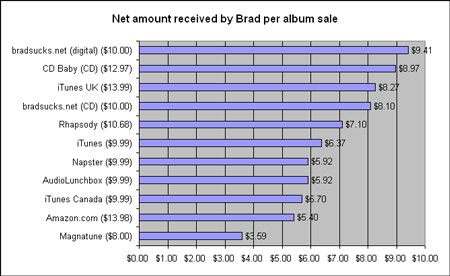
For independent artists it’s simpler of course as we have no record label loans to pay back, but there’s still a lot of mystery. I’m asked often where I get the most money from awesome people who want to make sure their dollars go to me. Today in the interest of science and like… money… I did up some charts:

Net amount received by me per album sale. That’s the amount that actually goes into my pocket, so bank fees, postage, digital distribution fees, manufacturing and other charges along the way are factored in. The album price per service is listed next to the service name.
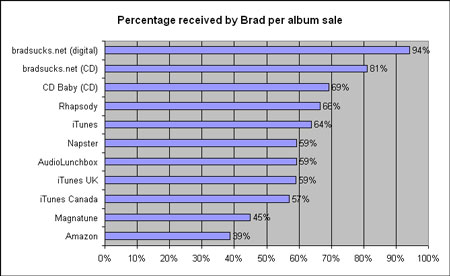
Percentage received by me per album sale, based on the same data above.

Neither of these graphs take into account any signup or yearly fees. Amazon is $30 a year and CD Baby (who handles all the other digital distribution for me) is a $35 one-time fee. I’m also not 100% sure I got the iTunes UK album price right and Magnatune lets buyers decide the price from $5-$18 so I used an average of $8 which I think I read somewhere.

Analysis

No big surprise, buying direct from me is the best (for me). Direct digital sales (using my free open source digital store, natch) is the best in profit and percentage as I only pay Paypal fees and a negligible Amazon S3 amount. I make more per sale on CD Baby and iTunes UK than direct CDs from me, but that’s only because the unit price is three or four dollars more.

It’s interesting how low Magnatune ranks in both charts. Magnatune is a non-exclusive record label that I’m on (and enjoy being on), but unlike other label agreements I referred to in the beginning of this post, I have no debt with them. It’s their decision to split the income and bank fees 50% with the artist, which means significantly less money for the artists than most other services.

Conclusion

It’s pretty simple. The less middlemen, the more money gets to the artist. The best would be to pirate the album and personally hand the artist a ten dollar bill. That would be as close to 100% as you’re going to get.

Posted to by Brad on 5/22/07 @ 1:13 pm |
« Lists for nerds | Bebo protects my copyright from me »


19 Responses to “Where your music money goes”


  1. 1
    Padraic

    Great post! I’ve always been curious about this kind of thing.

  2. 2
    Cheez

    Someone please digg this. I think a lot of people would like to see these graphs. Thanks for posting this Brad.

  3. 3
    Marco Raaphorst

    What about the amount of sales Brad?

    Are you also selling the most CD’s and download through your own website? If so: super great!

  4. 4
    Brad

    Marco: I don’t have sales data in a decent format so it’s pretty hard to do up charts for that.

    iTunes, Magnatune and my site seem to be the best.

  5. 5
    gurdonark

    I’ve seen this type of thing often in the usual cautionary “this is your brain on a major label contract”, but it’s good to see it
    for “here are a selection of indie and DIY distribution options”.

    As in many ways these are not so much “competing” channels of distribution as “alternatives for distribution”, I imagine that it is not so important whether magnatune nets you 4 and cdbaby nets you 13. I think it’s instead important that the combination of outlets nets you a stream of payments.

    I would be intrigued, too, as your career develops, to see if the buyer who found you through, say, Rhapsody, is more apt to buy from your site the second time around.

  6. 6
    Moses de los Santos

    Have you considered bathtubmusic.com?

    - FREE UNLIMITED ALBUM UPLOADS!!
    (we retain $.30 per song

    - $9.95 Per CD (to store, wherehouse and manage orders)
    (We reatin $3. per Physical CD sold.

    Thats not so bad…is it?

    So what are you waiting for?? GET IN THE TUB!

    Thanks for allowing me to comment.

    Best regards,

    Moses de los Santos
    President/CEO
    Bathtubmusic.com
    “Where the MUSIC makes a Splash!”
    myspace.com/bathtubmusic

  7. 7
    Brad

    gurdonark: definitely they’re not really competing, it’s all good for me. Most music buyers don’t really care or think about how much goes to the artist, they go by what’s most convenient for them, which is understandable. So if Amazon.com works for them, then that’s cool with me.

    I don’t know how many people come back from those services. I don’t get access to names or email addresses or anything on most statements, so it’s all mysterious.

  8. 8
    Brad

    Moses: it’s not a bad cut, but I’d have to think I’m missing out on a decent number of potential sales to go through the effort of uploading my music to a new service.

    I pretty much leave it up to CD Baby to put my record into any hot new digital download services and so far they haven’t let me down.

  9. 9
    Plat

    What’s the emusic.com payback like? (Or is that grouped into the CD Baby earnings?)

    I always wondered how that was determined, especially when they were all-you-can-eat.

  10. 10
    Brad

    Plat: eMusic’s a little weird, I’m not sure how it works. It looks like I get $0.172 for a single song, but if one song is bought multiple times, it’s $0.278 each.

    They’re all listed as purchases instead of listens so I don’t know why it’d be different.

  11. 11
    Hometracked - Independent artist CD sales analysis

    [...] posted a great article this week on which CD sales approaches pay independent artists the most. His experience mirrors mine: Direct sales are the most profitable, followed by CD Baby, then the [...]

  12. 12
    Harei Edom

    It’s hard to read your timely wisdom on the new reality of direct music sales by the new generation of online independent artists, and not mention one website that is committed to helping such unsigned artists in a big way.

    The site is called CDs-FROM-THE-ARTIST dot com, or CFTA for short, found at:

    http://www.cdsfromtheartist.com

    It’s a site created and maintained by indie artists for indie artists, completely free to indie artists and music lovers. Please spread the word about this site among unsigned artists. The “I am an Indie Artist” link from their options bar is very informative.

    Regards,
    Harei

  13. 13
    cheez

    I can’t get over how great this post is. I’ve referred to it several times already.

  14. 14
    {{ lynette radio }} » Thinking about music lately

    [...] cash than ones produced, marketed, and distributed by Universal Music.  Googling around I did find one artist’s breakdown on how much he makes on his music, and from where, but that’s about [...]

  15. 15
    Orwell's Ghost

    What are your thoughts on the media blasting Radiohead saying they flopped with their publicity stunt?

    It was reported they got 1.2 million downlaods, and that was in mid October, and they made nearly 6-10 million dollars on the average price spent of being 5 bucks, but reports now varies from between 2 bucks to 8 bucks.

    And I can only guess they did roughly another million downloads, so based on those figures…

    do you think they still made roughly the same amount they would have if they released the album with a label?

  16. 16
    Brad

    It’s pretty hard to compare Radiohead’s career and anybody else’s. Certainly they kept the costs way lower than they would have with a label. And this doesn’t rule out a label release, so it’s all gravy.

    If we assume the record was going to leak anyway, they’ve managed to make a couple million dollars off of doing that themselves. I can’t see how that could not be considered a huge win.

    There are a lot of dimensions to the consumer mindset though. Some people are more willing to give their money to Radiohead, some are less willing. Ultimately I think most consumers are pretty sure that Radiohead really doesn’t _need_ their money — that Radiohead are set for life millionaires. How does that impact where people decide to throw their music money?

  17. 17
    Another Great Wired Piece With David Byrne On The Music Business by Graham English

    [...] his personal feelings affect his argument, which overall is very good. In the same conversation, Brad Sucks presented a chart on where your music money goes. It’s a great detailed view from the perspective of a self-produced and distributed one-man [...]

  18. 18
    Cultural Shift(s) » Will Fans Pay? Selling and Distributing Music Online

    [...] little information on how much William’s would have received out of that total. Data  from one analysis indicates that Williams could have received about 39% of his album sales when sold in CD format [...]

  19. 19
    Seamus Anthony

    This shit is rockin’ my world dude - as is your music. Good work old bean :-)


Leave a Reply

my other sites: in4mador!, stripcreator